
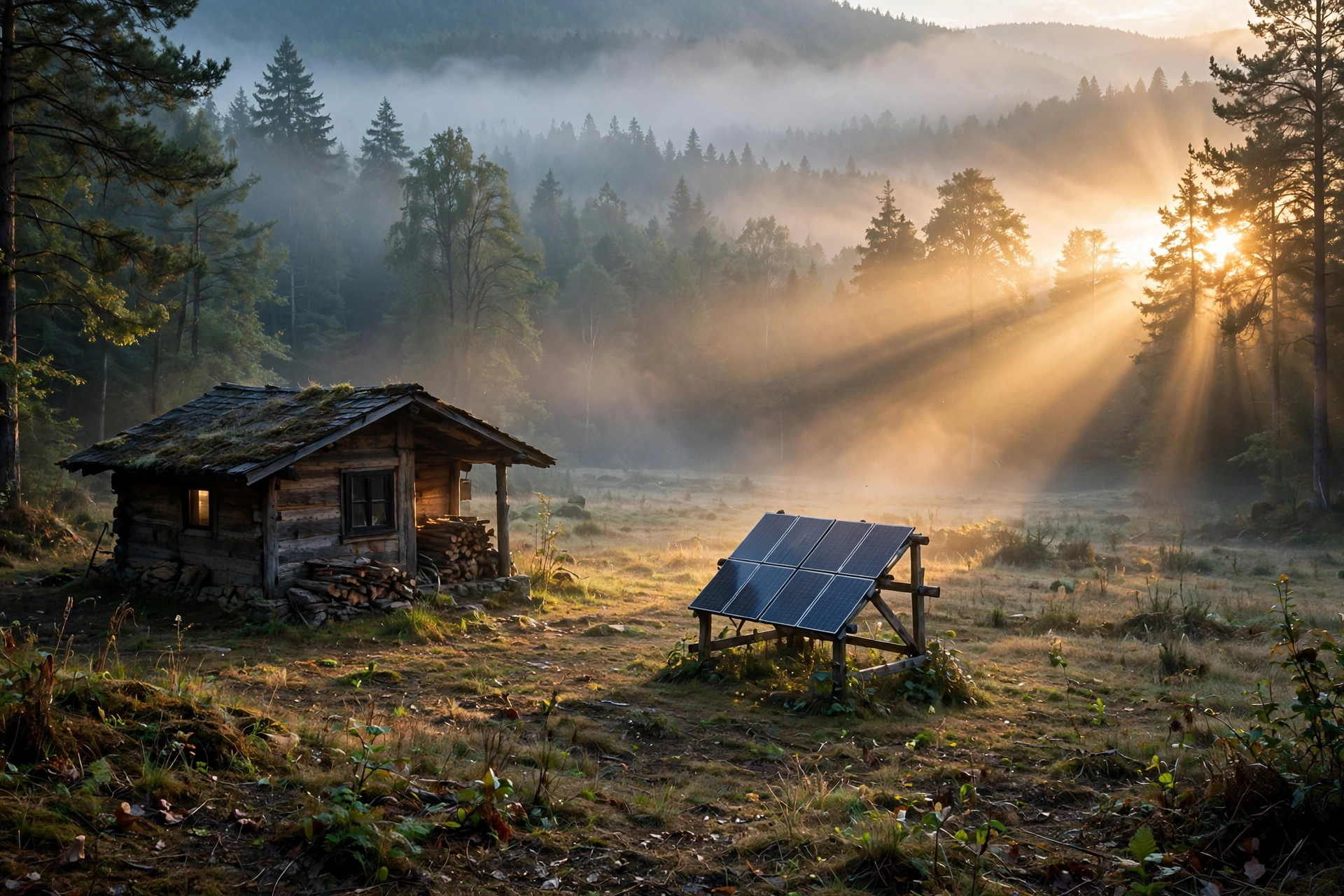
The short answer: sunlight carries energy, and there are two ways to catch it — turn it into electricity with a photovoltaic panel, or turn it into heat with a thermal collector. Everything else in solar energy is detail built on those two conversions. Light in, usable power out, with no fuel burned and no moving parts in the panel itself.
Disclosure: Powered by Solar Panels is reader-supported. Some links on this site may earn us a commission if you buy through them, at no extra cost to you — see our disclosure for the full picture. This guide contains no affiliate links; it is purely explanatory, based on published research as of October 2026.
Start with the sun
The sun is a fusion reactor about 150 million kilometres away, and it radiates an almost absurd amount of energy. The often-quoted figure, from sources including the BBC and Caltech, is that the sunlight striking Earth’s surface in roughly two hours carries as much energy as humanity uses in an entire year. Almost all of it goes unused — it warms the ground, evaporates water, and bounces back into space.
Solar energy is simply the act of intercepting some of that flow before it is wasted. A surface that absorbs sunlight instead of reflecting it can put the captured energy to work. The question is only what form the work takes, and that is where the two paths split.
Path 1: sunlight into electricity (photovoltaic)
This is the path most people mean when they say “solar power.” A photovoltaic (PV) panel is made of cells of a semiconductor material — almost always silicon — arranged under glass in a metal frame. When photons of sunlight strike a cell, they knock electrons loose from the silicon atoms. The cell is built with an internal electric field that pushes those freed electrons in one direction, and a flow of electrons in one direction is an electric current.
That current is direct current (DC): it flows one way, like the power from a battery. Most appliances run on alternating current (AC), so an inverter converts the DC into AC before it is used. In an off-grid setup — an RV, a cabin, a campsite — the chain is usually panel → charge controller → battery → inverter → appliance, with the battery storing daytime surplus for use after dark.
The key first principle: a PV panel converts light, not heat. It responds to photons, which is why panels still produce on a bright overcast day and why they can actually perform slightly better in cool, sunny conditions than in scorching heat. Heat is the enemy of a PV cell’s efficiency, not its fuel.
For the full step-by-step of what happens inside a panel, see How Do Solar Panels Work?.
Path 2: sunlight into heat (solar thermal)
The second path is older and simpler. A solar thermal collector is essentially a dark surface that absorbs sunlight and gets hot, transferring that heat to a fluid — usually water, sometimes air. There is no semiconductor physics involved; it is the same principle as a black garden hose left in the sun, engineered to be efficient.
At small scale, a flat-plate or evacuated-tube collector on a cabin heats water for showers and washing. At large scale, mirrors concentrate sunlight onto a receiver to make steam and drive a turbine — concentrated solar power. The mechanism differs from PV in one important way: thermal systems store heat easily. A tank of hot water stays hot after sunset, while a PV panel stops the moment the light stops. That is why thermal is often the better tool when the job is heat itself rather than electricity.
| Solar PV | Solar thermal | |
|---|---|---|
| Converts sunlight into | Electricity | Heat |
| Core component | Silicon photovoltaic cell | Dark absorber + fluid |
| Output form | DC, then AC via an inverter | Hot water or hot air |
| Works in cloud | Yes, at reduced output | Yes, at reduced output |
| Works at night | No — needs stored battery power | Yes, from stored hot water |
| Best off-grid job | Powering lights, fridges, devices | Showers, washing, space heating |
Why the sun’s energy is so abundant — and so dilute
If sunlight is so plentiful, why does it take a whole panel to charge a phone? Because solar energy is abundant in total but dilute per square metre. Around 1,000 watts of sunlight fall on each square metre at noon on a clear day, and a typical panel converts roughly 20% of that into electricity — about 200 watts per square metre. That is the fundamental constraint of solar: it is a surface-area game. More power means more panel area, or more efficient cells, and nothing else.
This is also why orientation and shade matter so much. A panel in full sun at midday produces several times what the same panel produces under a tree branch or at a steep angle to the sun. The energy was never stored in the panel; it arrives moment by moment with the light, so anything that blocks or weakens the light cuts output immediately.
What happens when the sun goes down
A solar panel produces nothing at night — no light, no photons, no current. This is the single biggest practical fact about solar energy, and every off-grid system is designed around it. The standard answer is storage: daytime surplus charges a battery (usually lithium iron phosphate in modern portable setups), and the battery powers your loads after dark. The panel is a daytime harvester; the battery is what makes the harvest usable around the clock.
Cloudy days sit between the two extremes. Panels keep working on diffuse light, typically producing around 10–25% of their clear-sky output depending on how thick the cloud is. That is enough to keep a small off-grid system ticking over, but not enough to refill a battery quickly — which is why off-grid sizing is done on the worst realistic week, not the best day.
Solar energy in an off-grid setup
Put the pieces together for a typical RV or cabin, and the flow looks like this:
- Sunlight hits the panels and PV cells convert photons into DC electricity.
- A charge controller regulates that DC so it charges the battery safely, without overcharging.
- The battery stores the energy for use when the sun is not shining.
- An inverter converts stored DC into AC for standard appliances, or DC loads run directly from the battery.
- A thermal collector, if you have one, separately heats water straight from the sun — no electricity involved.
No part of that chain burns fuel, and the only moving parts are in the inverter’s electronics and any fans. That simplicity is why solar suits remote setups so well: there is very little to break, and the fuel arrives free every morning.
The limits, honestly stated
Solar energy is not magic, and the honest version of the story includes its limits. It is intermittent — it follows the sun, not your schedule. It is dilute — you need real surface area for real power. And the equipment has an embodied cost: mining silicon, manufacturing panels, and eventually recycling them all take energy and materials. Panels typically carry performance warranties of 25 years and keep producing well beyond that, which is what makes the lifetime maths work, but the panels themselves are not free of environmental cost.
What solar does uniquely well is turn the most abundant energy flow on the planet into electricity and heat with no combustion, no noise, and almost no maintenance. For an off-grid cabin, an RV, or a campsite, that trade — a panel, a controller, and a battery in exchange for power wherever the sun shines — is the whole appeal. If you want to understand the panel itself in depth, start with our guide to how solar panels work, and when you are ready to compare hardware, browse the solar panels hub.