
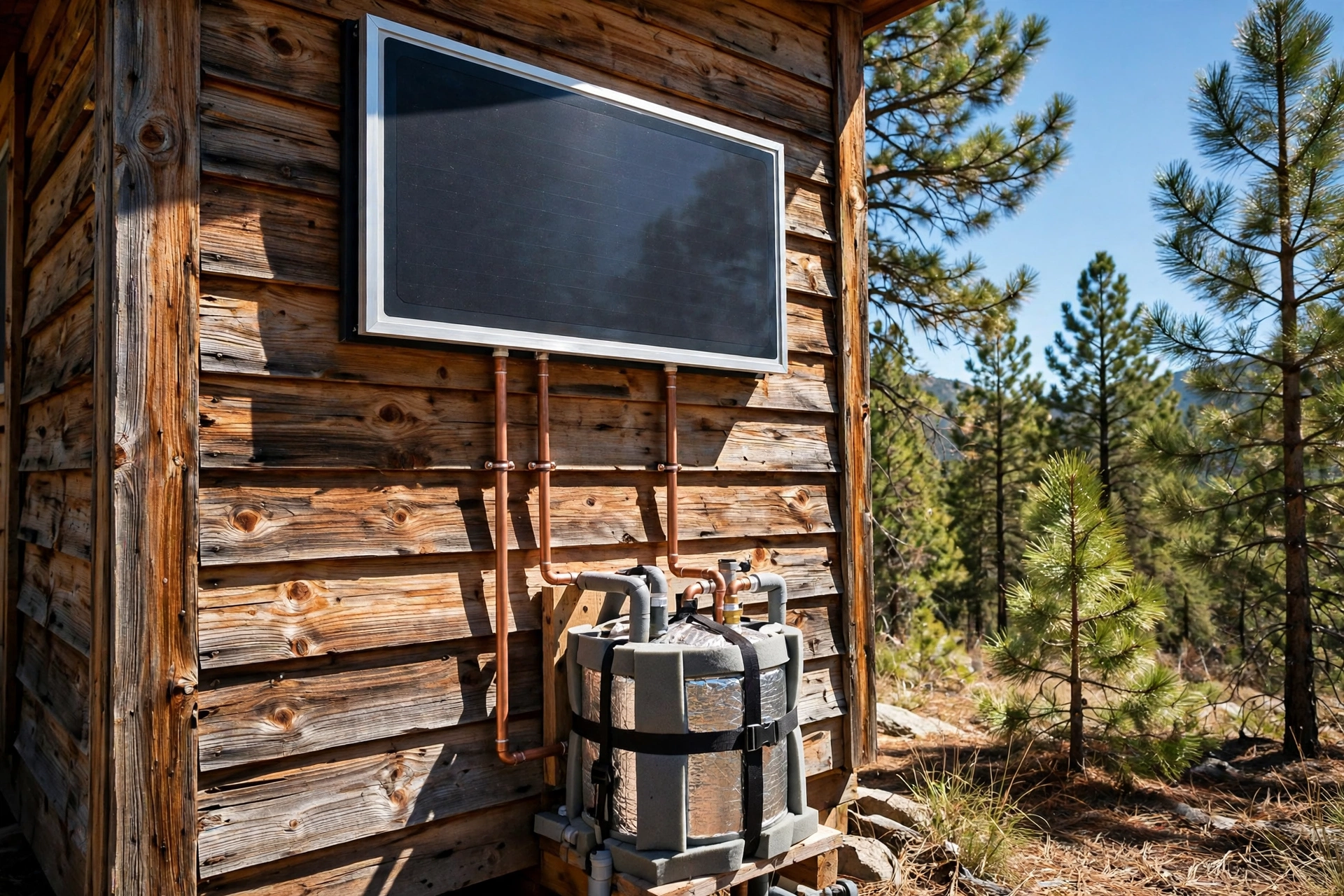
The short answer: a flat-plate solar collector is a dark metal plate inside an insulated box under glass, and it turns sunlight directly into hot water. No solar panels, no battery, no inverter. Sunlight heats the plate, the plate heats water or a freeze-proof fluid in tubes behind it, and that hot fluid carries the heat to an insulated tank. For a cabin or an off-grid setup it is the oldest, simplest, toughest way to get solar hot water.
Disclosure: This guide contains no affiliate links. Any links below go to manufacturers and information sources, and we may earn a commission if you buy through a link on this site — but this article itself contains no affiliate links. Read our full affiliate disclosure.
How we researched this: we did not test these collectors hands-on. This guide is based on manufacturer documentation, off-grid builder guides, and owner reports published in 2025 and 2026, as of October 2026. Prices are typical US ranges for small DIY kits and change often, so check the live price before you buy. Everything here is framed for DIY, cabin, and portable off-grid use.
How it works: the box, first principles first
A flat-plate collector looks like a shallow, dark window, and each part solves one specific heat problem.
The absorber plate is the working heart: a sheet of copper or aluminium, usually with a selective coating, that absorbs sunlight and turns it into heat. A good selective coating absorbs most incoming sunlight while giving off little heat as infrared radiation, unlike cheap black paint. The plate is bonded to a grid of copper tubes, so the heat it collects flows straight into the fluid inside them — light becoming heat is nearly lossless, with a good absorber converting close to 95 percent of incoming light into heat.
The glazing is the sheet of tempered glass over the front. It lets sunlight in and traps heat: the hot absorber re-radiates energy as long-wave infrared, and glass is largely opaque to that. This greenhouse effect is why the collector is enclosed rather than a bare plate in the sun.
The insulation is the rigid foam or mineral wool behind and around the absorber, typically 2 to 3 inches thick. It stops heat escaping out the back and sides of the box.
The fluid loop carries heat from the collector to the tank. Fluid enters cold at the bottom, warms as it flows through the tubes, and leaves hot at the top. From the collector, the hot fluid runs through insulated pipes to the storage tank, gives up its heat, and returns to be heated again. Every metre of uninsulated pipe is a leak, so the tank belongs as close to the collector as the layout allows.
The result: a good flat-plate collector converts roughly 40 to 60 percent of the sunlight hitting it into useful heat in typical conditions, and up to around 70 percent in warm, sunny weather. Most of the loss is heat escaping through the glass and casing on cold or windy days, and that fact drives every design decision that follows.
Put together, the collector is a heat exchanger with a greenhouse on the front and a blanket on the back, and well-built flat plates routinely last 15 to 25 years with little more than an annual check and a clean of the glass. For comparison, a photovoltaic panel converts only about 20 to 25 percent of sunlight into electricity — see our guide to how solar energy works.
Direct vs indirect: what flows through the collector?
Direct (open-loop) systems circulate the water you will actually use: cold water from the tank flows through the collector, heats up, and returns. This is the simplest and most efficient layout — no heat exchanger, no second fluid. It is also the most fragile: below freezing, the water in the collector and its pipes can freeze, expand, and burst the copper tubes. Direct systems therefore suit warm climates where freezing is rare.
Indirect (closed-loop) systems circulate a separate fluid — usually a propylene-glycol and water mix — through the collector, and that fluid hands its heat to the tank water through a coil inside the tank. The glycol mix will not freeze at any temperature a cabin is likely to see. The costs are a heat-exchanger loss of roughly 10 percent, the price of the glycol, and a check of the mix every couple of years. For any site with real winters, this is the system to build.
| Direct (open loop) | Indirect (closed loop) | |
|---|---|---|
| Fluid in collector | The water you use | Propylene-glycol mix |
| Efficiency | Higher — no heat exchanger | Roughly 10% lower across the coil |
| Freeze protection | None — pipes can burst | Good — glycol does not freeze |
| Maintenance | Minimal | Glycol check every 2 years |
| Best for | Warm climates, no frost | Cold climates, year-round cabins |
If your site freezes at all, build indirect — a burst collector costs more than years of glycol checks.
Thermosiphon vs pumped: how the fluid moves
Thermosiphon (passive) systems need no electricity at all. Hot fluid is lighter than cold fluid, so it rises naturally from the collector into a tank mounted above it, while cold fluid sinks down to be heated. The loop runs itself as long as the sun shines: no pump, no controller, no power draw. The catch is geometry: the tank must sit above the collector, usually on a raised rack or wall bracket, and a filled 150-litre system weighs over 400 lb, so the rack has to be built for that. Thermosiphon also works best as a direct system, limiting it to warm climates unless you run glycol in the loop.
Pumped (active) systems use a small pump and a controller. A sensor compares the collector and tank temperatures, and when the collector is hotter, the controller switches the pump on. The pump’s draw is tiny — a 12V pump uses a few watts — so it is a trivial load for even a small off-grid solar power system. Pumped systems let you put the tank wherever you want, including inside the cabin at ground level, and they work with indirect glycol loops for freeze protection. The cost is complexity: a pump, a controller, and sensors that can each fail.
| Thermosiphon (passive) | Pumped (active) | |
|---|---|---|
| Needs electricity? | No | Small 12V pump |
| Tank position | Above the collector | Anywhere |
| Freeze protection | Poor as direct; workable with glycol | Good with glycol loop |
| Failure points | Almost none | Pump, controller, sensors |
| Best for | Warm-climate cabins, simplest setup | Cold climates, flexible layout |
The practical rule: warm climate, go passive thermosiphon; cold climate, go pumped indirect with glycol.
Sizing a flat-plate system for a cabin or RV
Daily demand first. Off-grid living with low-flow fixtures uses about 10 to 15 gallons of hot water per person per day. Two people need roughly 20 to 30 gallons a day; four people need roughly 40 to 60.
Collector area second. Plan on about 15 to 20 square feet of collector per person. A standard panel is 4 by 8 feet, or 32 square feet, so a two-person cabin typically needs one to two panels, and a four-person cabin needs two to three. In a cold or cloudy climate, add 20 to 30 percent more collector area; in a very sunny one, trim 10 to 15 percent. A single 4 by 8 foot collector produces roughly 1,500 to 2,500 BTU per hour in full sun, enough to heat 30 to 50 gallons per day.
Tank size third. Size the tank at roughly 15 to 20 gallons per person — 40 to 60 gallons for two people, 60 to 80 for four. The tank needs to be bigger than daily demand because solar heat arrives in a lump during the day and has to last until the evening shower.
Orientation and tilt. Face the collector south in the northern hemisphere, tilted at roughly your latitude. A ground rack or wall mount makes this easy to adjust; a fixed mount at the wrong angle quietly costs you a quarter of your output all year.
For an RV, the honest answer is different. A filled collector and tank weigh several hundred pounds, the glass is fragile on rough roads, and the plumbing is fixed, not portable. RVers who want solar hot water normally take a simpler route — a portable solar shower bag, or an electric tankless heater run from their existing off-grid electric system. The flat-plate collector is a stationary-cabin tool.
What it costs
Small DIY solar water heater kits for cabins — a collector plus a tank — commonly run about $1,000 to $3,000 depending on size, before mounting, plumbing, and a backup heater. Flat-plate kits sit at the lower end of that range; evacuated-tube kits at the higher end. A fully plumbed pumped indirect system with a glycol loop, pump, controller, and propane backup can run higher, but still far below a comparable electric setup once you count the panels, battery, and inverter.
Running costs are small: a glycol check every couple of years, an occasional clean of the glass, and eventually a replacement pump or controller. A flat-plate collector has no moving parts of its own, so there is little to wear out. Expect 15 to 25 years of service from a well-built panel with basic care.
A flat-plate system makes hot water and nothing else — it cannot run lights, charge a phone, or power a fridge. If you need electricity too, you need a separate electric system. Compare panel options in the solar panels hub.
Freeze protection
Freezing is the single most common way a DIY flat-plate system dies in its first winter.
Glycol (indirect loop) is the standard answer. A propylene-glycol mix in the collector loop will not freeze at cabin temperatures. The price is the heat-exchanger loss and the maintenance: check the glycol concentration and pH every two years.
Drainback is the other reliable option. The collector loop drains itself by gravity into a small reservoir tank whenever the pump stops — at night, on cloudy days, or in a power cut. With no fluid in the collector, there is nothing to freeze. It adds no heat-exchanger loss, but every pipe must slope continuously down to the reservoir, with no low spots where water can pool and freeze.
Controller recirculation runs the pump briefly when the collector temperature nears freezing, circulating warm tank water through the collector. It works, but it needs power and a working pump and controller on the coldest night of the year. Treat it as a backup layer, never as the only protection. Manual draining costs nothing and cannot fail, but it means no solar hot water all winter, and only works if someone is at the cabin before the first freeze.
Flat-plate vs evacuated tube, briefly
An evacuated-tube collector is a row of double-walled glass tubes with the air pumped out of the gap — a vacuum, like a thermos flask. The vacuum insulates the absorber, so the tubes keep producing useful heat on cloudy days and in deep winter, and they collect light from a wider range of sun angles, so they are less fussy about exact orientation.
What they cost is real: roughly twice the price per square foot, fragile glass tubes (though individual tubes can be replaced), and more weight. They also have two quirks flat plates do not: they do not shed snow — a flat plate’s heat loss melts snow off its glass, while snow can sit on evacuated tubes — and they are harder to protect from overheating, because you cannot drain back an evacuated-tube collector, so a tube system left idle on a hot summer day needs a heat dump.
| Flat-plate | Evacuated tube | |
|---|---|---|
| How it holds heat | Insulated box, glass cover | Vacuum inside each tube |
| Cold-weather output | Drops sharply | Holds up well |
| Cloudy-day output | Weak | Usable |
| Snow | Melts off the glass | Can sit and block the sun |
| Toughness | Tempered glass, hail-resistant | Fragile tubes, replaceable individually |
| Overheat protection | Drainback works well | Needs a heat dump |
| Cost per square foot | Lower | Roughly double |
| Best for | Warm, sunny sites | Cold or cloudy sites, year-round cabins |
At peak output on a sunny day the two perform similarly — the difference shows up on the marginal days. Buy the collector for your worst season, not your best day. For the whole water-heating picture, see our guide to solar water heaters.
Common mistakes
Oversizing the collector and undersizing the tank. More collector means hotter water faster, but also overheating on peak summer days, when a small tank can push past safe temperatures. A working controller, a pressure relief valve, and a way to dump excess heat are not optional.
Forgetting the non-return valve. Without one, hot water can flow backwards through the loop at night, cooling the tank by radiating heat out of the collector into the night sky. A cheap valve prevents it; forgetting it quietly wastes a large share of each day’s heat.
No backup heat source. A week of cloud means a week of backup heat. Almost every off-grid setup pairs solar with a propane on-demand heater or an electric element. Size the backup for your worst stretch, not your average day, and set its thermostat low — around 110 to 120°F — so solar does the heavy lifting.
Mounting in partial shade. A collector shaded by trees for half the day works half as well. Site it where the sun actually falls, which may mean a ground rack away from the cabin rather than the nearest wall. Check the site at the winter solstice, when shadows are longest.
Where it fits in your off-grid setup
An off-grid cabin has two energy systems sharing a site. The thermal system — this one — handles hot water, the biggest heat job in most cabins, at roughly 40 to 70 percent efficiency from sunlight. The electric system — panels, charge controller, battery, inverter — handles everything else at 20 to 25 percent, and should not be wasted on heating water. Keep the jobs separate and both systems stay small and cheap.
A flat-plate collector is the right thermal choice when your site is warm and sunny, your budget is tight, and you value toughness and simplicity. It is a box of glass, copper, and insulation with no moving parts — and after decades of solar water heating, that is still hard to beat.