
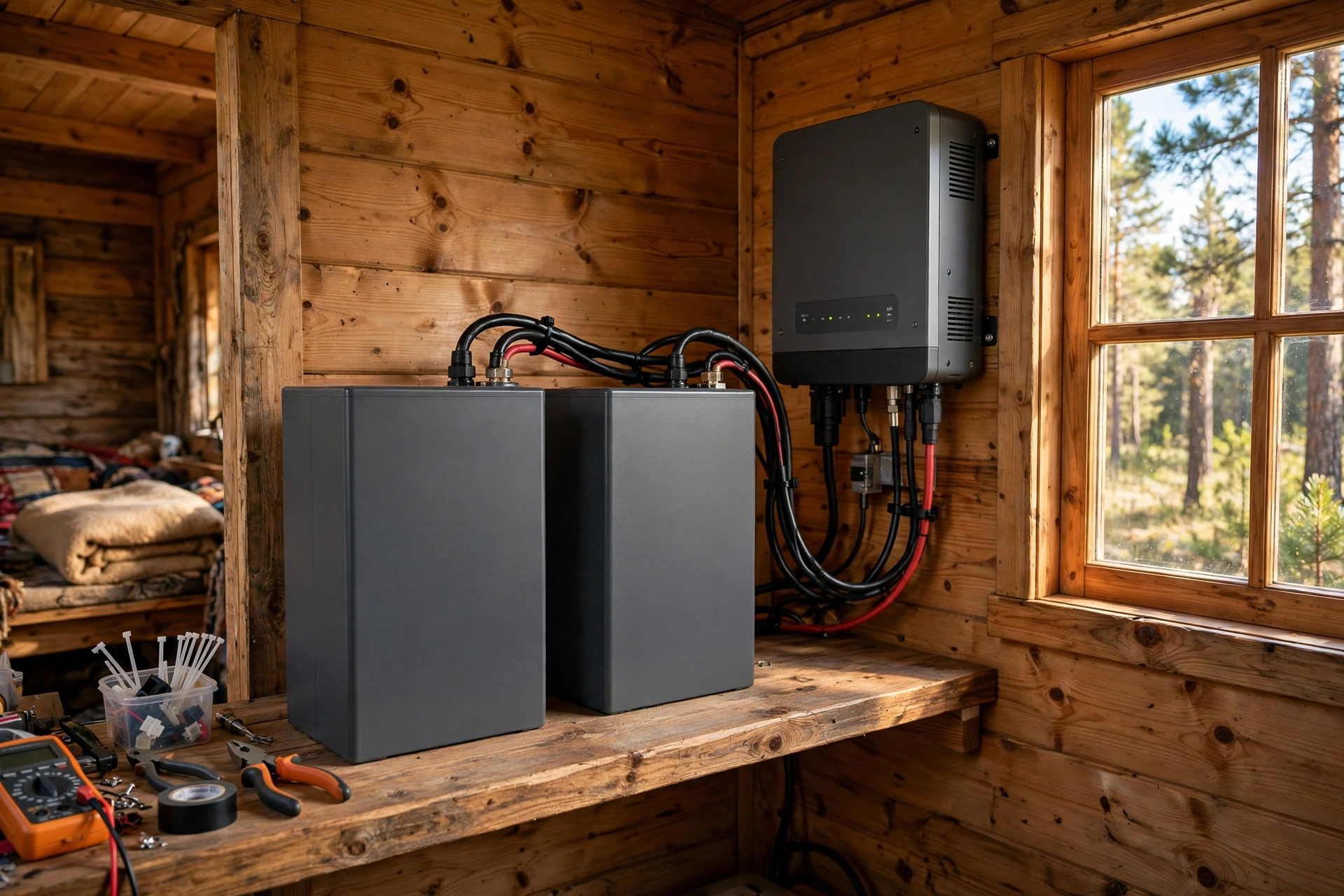
The short answer: a solar battery is the part of your system that turns sunshine into power after dark — and the number on the label is not the energy you actually get to use. Panels make power only while the sun shines. A battery stores that energy so your lights, fridge, and laptop keep running at night and through cloudy days. But a 100 amp-hour battery does not give you 100 amp-hours of usable energy: how much you can safely draw depends on the chemistry, and draining a battery too deeply is the fastest way to kill it.
Disclosure: this guide is research, not hands-on testing — every figure below comes from published manufacturer specs and independent guides as of October 2026. We may earn a commission if you buy through links on this site; there are no affiliate links on this page. See our disclosure for how the site is funded.
Why a battery, and what it actually stores
Think of a solar system as two separate problems. Panels solve the power problem: they convert sunlight into electricity, measured in watts. Batteries solve the time problem: they store that electricity, measured in watt-hours, so it is available when the panels are not producing.
The three battery types that matter
For DIY and portable solar, the realistic choice comes down to three chemistries. Flooded lead-acid — the old open-cell batteries you top up with distilled water — still exists, but it vents hydrogen, needs ventilation and regular maintenance, and spills if tipped, so it is a poor fit for RVs, cabins, and portable kits.
LiFePO4 (lithium iron phosphate)
LiFePO4 cells use iron phosphate instead of the cobalt or nickel oxides in phone batteries, making them far more resistant to overheating and thermal runaway — which is why they dominate off-grid solar.
A LiFePO4 battery is a pack of cells plus a battery management system (BMS) — a circuit board that watches every cell and cuts off charging or discharging if voltage, current, or temperature goes out of range. The BMS is not optional trim; it is what makes a lithium battery safe to use in a DIY system.
Its strengths: you can use 80 to 90% of its rated capacity regularly, it delivers 3,000 to 6,000 cycles at that depth, and it charges efficiently (round-trip efficiency around 95%). Its weaknesses: higher upfront price, and it must not be charged below freezing unless the battery has a heater or low-temperature cutoff.
AGM (absorbent glass mat)
AGM is a sealed lead-acid battery. The electrolyte is absorbed into fibreglass mats between the plates, so there is nothing to spill and nothing to top up. It is the cheapest way to get a working battery bank.
Its rules are stricter than lithium’s. Regular use should stop at about 50% depth of discharge — drain an AGM to empty repeatedly and its cycle life collapses. At 50% depth it delivers roughly 400 to 800 cycles. It is also heavy: a 12V 100Ah AGM weighs about 30 kg, more than twice its lithium equivalent. And it charges less efficiently, with round-trip efficiency around 80 to 85%.
Where AGM still wins: upfront price, cold charging, sitting at full charge for months, and simplicity — no BMS, just the right lead-acid voltage profile.
Gel
Gel batteries are the other sealed lead-acid type. The electrolyte is a silica gel instead of a liquid or a mat. They behave much like AGM — same 50% practical depth of discharge, similar weight — but they tolerate heat better and tolerate being left partially charged for long stretches, which suits hot climates or systems that sit idle between uses. Cycle life is a little better than AGM, roughly 500 to 1,500 cycles at 50% depth. They are sensitive to overcharging: too high a voltage creates gas pockets in the gel that never heal, so the controller must use the gel profile.
| LiFePO4 | AGM | Gel | |
|---|---|---|---|
| Practical depth of discharge | 80–90% | 50% | 50% |
| Typical cycle life at that depth | 3,000–6,000+ | 400–800 | 500–1,500 |
| Usable energy from 12V 100Ah | ≈ 1,000 Wh | ≈ 600 Wh | ≈ 600 Wh |
| Round-trip efficiency | ≈ 95% | ≈ 80–85% | ≈ 80% |
| Weight, 12V 100Ah | ≈ 12 kg | ≈ 30 kg | ≈ 32 kg |
| Charging below 0 °C | No, unless heated/protected | Yes, slower | Yes, slower |
| Maintenance | None | None | None |
| Typical price, 12V 100Ah | ≈ $150–$340 | ≈ $100–$150 | ≈ $120–$200 |
Typical ranges from manufacturer datasheets and independent comparisons as of October 2026. Always check the datasheet of the specific battery you buy.
Usable capacity: the number that actually matters
Headline capacity is what the label says: a 12V 100Ah battery stores 12 × 100 = 1,200 watt-hours. Usable capacity is what you can actually draw out without damaging the battery — headline capacity multiplied by the safe depth of discharge.
For a 12V 100Ah battery:
- LiFePO4 at 85% depth: 1,200 × 0.85 ≈ 1,020 Wh usable
- AGM at 50% depth: 1,200 × 0.5 = 600 Wh usable
- Gel at 50% depth: 1,200 × 0.5 = 600 Wh usable
Same label, nearly double the usable energy from lithium. That is why comparing batteries by price per amp-hour is misleading. The honest comparison is price per usable kilowatt-hour: divide the price by the usable energy. A $200 LiFePO4 battery giving 1,020 usable watt-hours costs about $196 per usable kWh. A $120 AGM giving 600 usable watt-hours costs about $200 per usable kWh — and the lithium battery will outlast several AGMs.
Depth of discharge (DoD) also drives cycle life, and the relationship is not linear. Draining a lead-acid battery to 80% instead of 50% can cut its remaining cycle life by half or more. With lithium the penalty is gentler, but it still exists: a LiFePO4 battery cycled to 60% instead of 100% lasts substantially longer.
How to size a battery bank
Sizing a battery is arithmetic. Work in watt-hours, not amp-hours, because your loads are rated in watts.
Step 1: Add up your daily use
List everything the system powers and multiply watts by hours per day. A realistic small cabin day:
| Load | Watts | Hours/day | Wh/day |
|---|---|---|---|
| LED lights (4 × 9W) | 36 | 5 | 180 |
| 12V fridge | 45 | 12 (compressor cycles) | 540 |
| Laptop + phone charging | 60 | 3 | 180 |
| Water pump | 60 | 0.5 | 30 |
| Small fan | 25 | 4 | 100 |
| Total | ≈ 1,030 Wh/day |
The fridge is usually the biggest load, and it runs whether you are there or not. Measure with a plug-in watt meter if you can.
Step 2: Convert to battery capacity
Divide daily watt-hours by battery voltage, then divide again by the usable depth of discharge:
Required amp-hours = daily Wh ÷ battery voltage ÷ usable DoD
For our 1,030 Wh cabin on a 12V system:
- LiFePO4 (85% usable): 1,030 ÷ 12 ÷ 0.85 ≈ 101 Ah
- AGM (50% usable): 1,030 ÷ 12 ÷ 0.5 ≈ 172 Ah
Step 3: Add autonomy and losses
One day of storage means one cloudy day kills the system. Most off-grid designs carry 1.5 to 2 days of autonomy — enough to ride out a dull stretch without draining the bank flat. And remember the inverter: converting 12V DC to mains AC loses roughly 10 to 15% as heat, so add about 15% if most of your loads run through an inverter.
For the cabin above, with 2 days of autonomy and an inverter:
- LiFePO4: 101 Ah × 2 × 1.15 ≈ 232 Ah → two 12V 100Ah batteries, or one 200Ah plus headroom
- AGM: 172 Ah × 2 × 1.15 ≈ 396 Ah → four 12V 100Ah batteries
That gap — two batteries versus four, about 24 kg versus 120 kg — is the practical difference the chemistry choice makes. See our off-grid solar power system guide for the rest of the system: size the battery to your loads, then the panels to recharge it.
Charging: the settings that decide battery life
A battery needs charging at the right voltages, in the right stages. This is the charge controller’s job, and the settings differ by chemistry.
LiFePO4 wants a simple profile: charge at about 14.2 to 14.6V (for a 12V battery), then stop. No float stage, no equalisation — holding a lithium battery at float voltage shortens its life, and equalisation voltages designed for lead-acid can damage it. Most modern controllers have a lithium setting; use it, and make sure equalisation is disabled.
AGM wants a bulk charge up to about 14.4 to 14.7V, then an absorption hold, then a float at about 13.5 to 13.8V. Skipping the absorption stage leaves the battery chronically undercharged, which causes sulfation — lead sulfate crystals that harden on the plates and permanently reduce capacity.
Two practical rules cover most failures: set the battery type on the controller before connecting the battery, and check it again after any factory reset or firmware update. Our charge controller guide covers the sizing and the cold-voltage checks in detail.
Temperature: the silent capacity thief
Cold. A lead-acid battery at −10 °C delivers noticeably less capacity than at 20 °C and charges more slowly, but cold charging does not damage it. A LiFePO4 battery can discharge in the cold without harm, but it must not be charged below 0 °C — charging a frozen lithium cell plates metallic lithium onto the anode and permanently damages it. Good LiFePO4 batteries have a BMS that refuses to charge in the cold; cheaper ones may not. If your battery lives somewhere unheated through winter, choose a model with low-temperature protection or a self-heating model.
Heat. Heat is the slow killer for every chemistry. A lead-acid battery kept at 30 °C instead of 20 °C can lose roughly half its calendar life. Lithium tolerates heat better, but sustained temperatures above about 45 °C still shorten its life. Keep batteries out of direct sun and away from inverter heat.
What batteries cost
Prices have fallen sharply for lithium in the last few years, which is what flipped the economics. Typical US prices as of October 2026, from current retail listings:
- 12V 100Ah LiFePO4: roughly $150 to $340, depending on brand, BMS features, and whether it has Bluetooth monitoring or low-temperature protection.
- 12V 100Ah AGM: roughly $100 to $150.
- 12V 100Ah gel: roughly $120 to $200.
- 12V 200Ah LiFePO4: roughly $300 to $680.
The number that matters is not the sticker price but the cost per usable kilowatt-hour over the battery’s life. A $200 LiFePO4 battery delivering about 1,000 usable watt-hours per cycle for 4,000 cycles moves roughly 4,000 kWh in its lifetime — about $0.05 per kWh. A $120 AGM delivering 600 usable watt-hours for 500 cycles moves about 300 kWh — about $0.40 per kWh. For a system that cycles only a few weekends a year, the maths flips: the AGM may never wear out before its calendar life expires, and the cheaper purchase wins.
When you are ready to compare specific models, our best LiFePO4 battery roundup breaks down the current options by size and use.
Safety: the non-negotiable parts
Batteries store a lot of energy in a small box, and a short circuit across a battery bank can deliver hundreds of amps — enough to melt wire and start a fire in seconds. These precautions are not optional:
- Fuse every battery. Put a fuse or DC breaker on the positive cable as close to the battery terminal as possible, sized to the wire, not the load. This is the single most important safety device in the system.
- Use proper cable. Battery cables must be thick enough for the maximum current the inverter can draw, with crimped or bolted lugs — not twisted bare wire under a screw. Undersized cable heats up, drops voltage, and can melt.
- Ventilate lead-acid. AGM and gel are sealed and barely gas under normal charging, but they can vent if overcharged. Flooded lead-acid vents hydrogen routinely. Never put any lead-acid battery in a sealed, unventilated space, and never near a spark or flame.
- Respect lithium’s BMS. The BMS is a safety device, not a convenience. Never bypass it, and never charge a LiFePO4 battery with a charger that has no lithium setting — an old lead-acid charger with an equalisation stage can push a lithium cell past its safe voltage.
- Keep terminals covered and tools insulated. Cover terminals, keep metal tools away from the bank, and remove jewellery before working on it — a dropped spanner across terminals is the classic DIY accident.
- Never mix chemistries or ages. Do not wire a lithium battery in parallel with an AGM, and do not add a new battery to a bank of old ones — the weaker battery drags the rest down and the strong one overcharges the weak one. If you expand a bank, match the model, capacity, and age.
A simple buying checklist
- Chemistry: daily cycling, weight-sensitive, or long-life system — LiFePO4. Occasional use, tight budget, cold charging, or a battery that mostly sits full — AGM. Hot climate or long idle stretches — gel.
- Usable capacity: work in watt-hours, divide by your usable depth of discharge, and add 1.5 to 2 days of autonomy plus about 15% for inverter losses.
- Cycle life: check cycles at your depth of discharge, not the headline number.
- Cold protection: if the battery will ever charge below freezing, confirm the BMS blocks low-temperature charging or the battery self-heats.
- Controller compatibility: your controller must have a profile for your chemistry, with equalisation disabled for lithium.
- Safety: a fuse at the battery, correctly sized cable, ventilation, covered terminals — before the first charge.
Get the chemistry, usable capacity, and charging profile right, and the battery becomes the quiet part of the system. Get any one wrong, and it becomes the part you replace — expensively, and sooner than expected.