
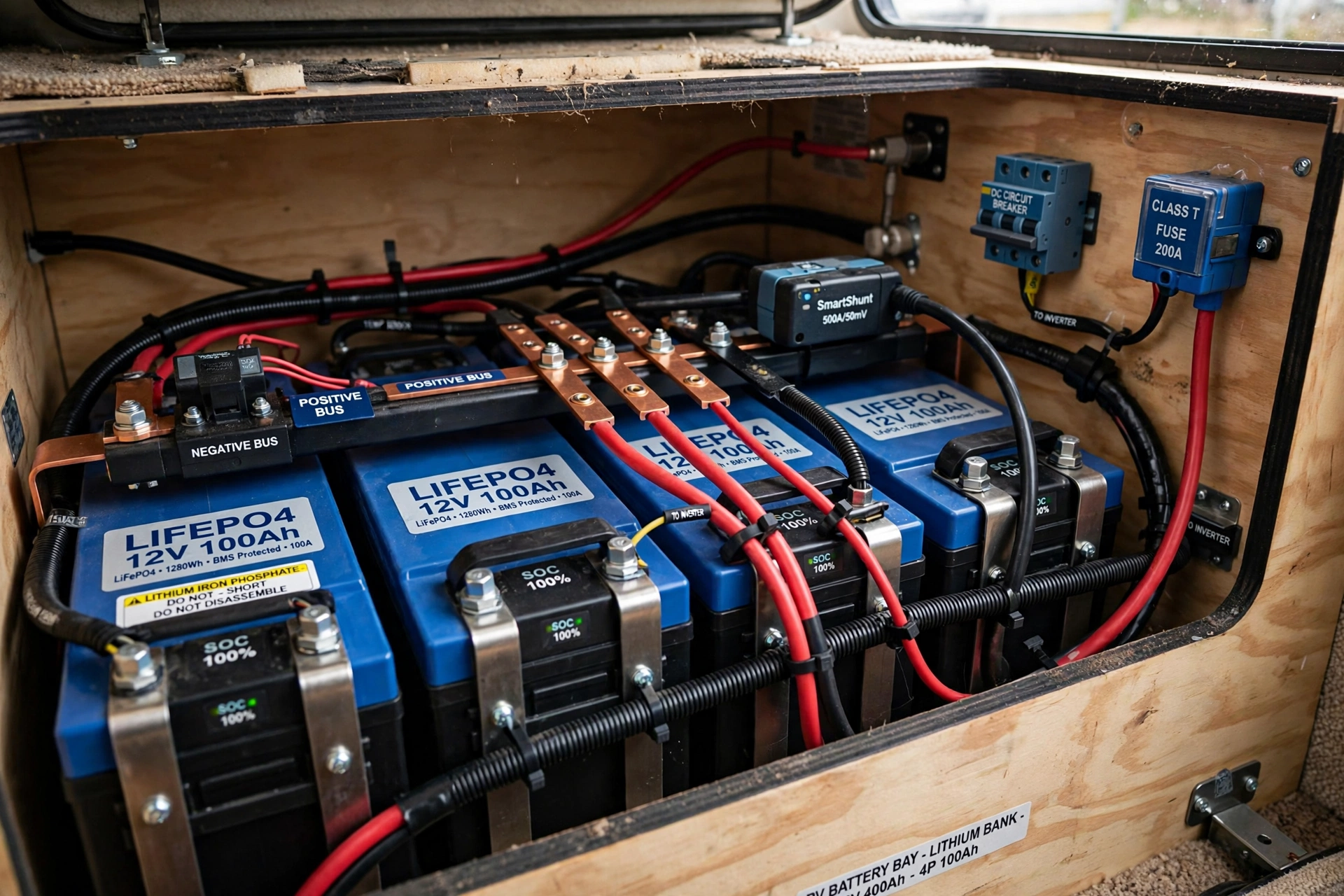
The short answer: the best LiFePO4 battery for most RV and off-grid solar setups is the LiTime 12V 100Ah, at about $336 as of October 2026. It stores 1,280Wh, delivers nearly all of it as usable power, is rated for 4,000+ full cycles, and weighs 24.25 lbs — about a third of an equivalent lead-acid bank. If you want the longest warranty and the strongest US support network instead, buy the Battle Born 100Ah at about $799. If you camp or live off-grid through freezing winters, buy the self-heating Renogy 12V 100Ah Pro at about $630.
Disclosure: we may earn a commission if you buy through links on this page, at no extra cost to you. Read our disclosure for how that works. Prices below are manufacturer list or sale prices checked in October 2026 and will move — treat them as a snapshot, not a quote.
This guide is a research roundup, not a hands-on test: every figure comes from published manufacturer specs, manuals, and owner reports as of October 2026. We did not test these batteries ourselves, and we say so because the battery market has a specific honesty problem — page after page of thin roundups quoting 8,000 to 15,000 cycle claims with no conditions attached. A cycle-life number without a depth of discharge is not a specification. It is a slogan.
What LiFePO4 actually changes
Lead-acid has been the default storage box for a century. Lithium iron phosphate — LiFePO4, also written LFP — changes it in four ways, and each one follows from the chemistry.
Usable capacity. A lead-acid battery is damaged by deep discharge, so the working rule is to use only about half its rated capacity. A 100Ah lead-acid battery gives you about 50Ah of usable power before you start shortening its life. LiFePO4 tolerates deep discharge: you can routinely use 80 to 100% of rated capacity. A 100Ah LiFePO4 battery therefore delivers about twice the usable energy of a 100Ah lead-acid battery of the same label. This is the single most important fact in this guide, because it means headline amp-hours mislead anyone comparing across chemistries.
Cycle life. A cycle is one full charge and discharge worth of energy — two half-discharges count as one. A typical lead-acid deep-cycle battery lasts 200 to 500 cycles. A LiFePO4 battery lasts 2,000 to 5,000 full cycles, depending on brand and conditions — roughly ten times the lifespan, which is why the higher purchase price usually wins on cost per cycle.
Weight. A 100Ah LiFePO4 battery weighs about 24 to 32 lbs. An equivalent lead-acid battery weighs about 60 to 70 lbs, and you need two of them to match the usable energy — so the real comparison is about 25 lbs against about 130 lbs. In an RV or van, that weight difference is payload you get back.
Safety. LiFePO4 is the most thermally stable lithium chemistry in common use. Unlike the lithium-ion cells in phones and laptops, it does not enter thermal runaway easily, which is why it is the standard choice for RVs, boats, and off-grid cabins where the battery lives beside where people sleep.
The usable-capacity math
Convert the label to energy first, then to usable energy:
| Battery | Label | Nominal energy | Usable energy |
|---|---|---|---|
| 100Ah lead-acid (for comparison) | 12V × 100Ah | 1,200Wh | About 600Wh (50% depth of discharge) |
| 100Ah LiFePO4 | 12.8V × 100Ah | 1,280Wh | About 1,024–1,280Wh (80–100% depth of discharge) |
| 230Ah LiFePO4 | 12.8V × 230Ah | 2,944Wh | About 2,355–2,944Wh (80–100% depth of discharge) |
Two rules follow. First, one 100Ah LiFePO4 battery replaces about two 100Ah lead-acid batteries in usable energy, at about a fifth of the weight. Second, when you see a cheap battery advertised by amp-hours alone, divide by the usable fraction before comparing prices.
Cycle life: how to read the claim
A cycle-life claim has three parts, and manufacturers quote whichever parts flatter them: the number of cycles, the depth of discharge, and the capacity remaining at the end — usually 80% of new. A claim that omits the depth of discharge is incomplete, and the omission is usually deliberate, because shallow cycles last far longer than deep ones.
LiTime publishes the full ladder for its 230Ah battery, and it is the clearest illustration of the effect:
| Depth of discharge | Claimed cycles to 80% capacity |
|---|---|
| 100% (fully drained every time) | 4,000+ |
| 80% | 6,000+ |
| 60% | 15,000+ |
The same battery is a 4,000-cycle battery and a 15,000-cycle battery, depending on how you use it. Only the first number describes daily off-grid use, where the battery is routinely drained hard. When a roundup page claims 8,000 or 15,000 or even 20,000 cycles for a 100Ah battery with no depth of discharge stated, that is almost certainly a shallow-discharge number quoted as if it were a full-cycle number — or invented outright. The live search results for this keyword are full of exactly that. Treat any cycle claim without conditions as marketing, and compare batteries on their 100% depth-of-discharge figure, or on their 80% figure if that is all that is published — never mix the two.
For calibration: Battle Born rates its 100Ah at 3,000 to 5,000 cycles; Dakota Lithium rates its 100Ah at 2,000 cycles to 80% capacity in recommended conditions, up to 5,000 under ideal conditions. The reputable brands cluster around 2,000 to 5,000 full cycles. A claim far above that range, from a brand with no datasheet to back it, is the tell.
The BMS: the small computer inside the battery
Every LiFePO4 battery in this guide has a built-in battery management system, a circuit board that watches the cells and disconnects the battery before damage happens. It stops charging above about 14.6V and discharging below about 10V, caps the current the battery will deliver — usually 100A continuous for a 100Ah battery — and cuts out instantly on a short circuit. It refuses to charge when the cells are below freezing, because charging a frozen lithium cell plates metallic lithium onto the anode and permanently damages it. Some batteries add self-heating, which warms the cells with a small amount of their own energy before charging resumes. And it keeps the four series cells inside the battery at equal voltage, so one weak cell does not drag the whole pack down.
The BMS is also the main reason cheap no-name batteries are a false economy. A battery is only as safe as its BMS, and a BMS you cannot inspect is a promise you cannot verify. The differences that matter in practice are the continuous discharge limit — a 100A BMS runs a 1,000W inverter comfortably but not a 2,000W one — and whether the battery has low-temperature charging protection and Bluetooth monitoring. The base LiTime 100Ah, for example, has no low-temperature charging cutoff: its own manual says to charge it only above 32°F.
The comparison
Prices are manufacturer or retailer prices checked in October 2026. Sale prices move frequently, especially at LiTime and Battle Born. Warranties: Battle Born 10 years, Renogy Pro 7 years, LiTime 5 years, Dakota Lithium 11 years.
| Battery | Capacity | Usable energy | Claimed cycles | Weight | BMS | Price |
|---|---|---|---|---|---|---|
| LiTime 12V 100Ah | 100Ah / 1,280Wh | About 1,024–1,280Wh | 4,000+ at 100% DoD | 24.25 lbs | 100A, no low-temp charging cutoff on base model | About $336 |
| Battle Born 100Ah 12V | 100Ah / 1,280Wh | About 1,024–1,280Wh | 3,000–5,000 | 31 lbs | 100A continuous, built-in | About $799 |
| Renogy 12V 100Ah Pro Smart | 100Ah / 1,280Wh | About 1,024–1,280Wh | 5,000 at 80% DoD to 80% capacity | 26.9 lbs | 100A, Bluetooth, self-heating, 60+ protections | About $630 |
| Dakota Lithium 12V 100Ah | 100Ah / 1,280Wh | About 1,024–1,280Wh | 2,000 to 80% capacity in recommended conditions | 27.5 lbs (heated Group 24) | 100A continuous, built-in | About $699–$795 |
| LiTime 12V 230Ah Plus | 230Ah / 2,944Wh | About 2,355–2,944Wh | 4,000+ at 100% DoD | 45.98 lbs | 200A, low-temp charging cutoff | About $484 |
The picks
Best overall: LiTime 12V 100Ah — about $336
The value case is arithmetic. At about $336 for 1,280Wh, it costs about $0.26 per watt-hour — roughly half the Renogy Pro and less than half the Battle Born — for the same usable energy and a 4,000+ full-cycle rating that matches or beats both. It weighs 24.25 lbs, fits a standard Group 31 compartment, and its 100A BMS handles a 1,000W inverter. LiTime’s own FAQ confirms it can be wired up to four in series and four in parallel.
The trade-offs are real. The base model has no Bluetooth monitoring and no low-temperature charging cutoff, so you charge it only above freezing. The warranty is 5 years, the shortest here, and support is a US warehouse backed by a China-based company rather than a US manufacturer. Buy the Bluetooth or self-heating variant if either limitation matters to you.
Best premium: Battle Born 100Ah 12V — about $799
Battle Born is the battery the RV industry itself installs. It is designed and assembled in Reno, Nevada, carries a 10-year warranty, and has the longest track record of any brand here — a decade of owner reports across RVs, boats, and off-grid cabins. The standard non-heated version is about $799 on sale (list about $949); a Smart version with Bluetooth monitoring is about $949, and a heated version exists for cold climates. The spec sheet is honest rather than flashy — 3,000 to 5,000 cycles, 100A continuous, 31 lbs — and you are paying for the warranty and US support. Buy it if the bank is a long-term investment in a rig you plan to keep.
Best for cold weather: Renogy 12V 100Ah Pro Smart — about $630
This is the only battery here that solves the freezing problem by itself. Its self-heating function warms the cells automatically when charging current above 4A is available and the temperature is below 41°F, so it can charge safely in sub-zero weather instead of refusing to charge at all. It also has built-in Bluetooth with app monitoring, an IP67 waterproof rating, and a 60+ protection BMS with a backup cut-off — the most thorough protection list in this roundup. Renogy rates it at 5,000 cycles at 80% depth of discharge to 80% end-of-life capacity, and backs it with a 7-year warranty.
One hard limit: the Pro can only be connected in parallel, up to eight batteries. It must never be wired in series, so it cannot build a 24V or 48V bank. If your system is 12V — as most RV and van systems are — that limit never bites. Buy it if you camp, fish, or live off-grid through freezing winters. If you never see freezing temperatures, the self-heating is dead weight and the LiTime is the better buy.
Longest warranty: Dakota Lithium 12V 100Ah — about $699–$795
Dakota Lithium’s headline is its 11-year warranty, the longest in this roundup, and its cold-weather pedigree: the battery discharges down to -20°F, and the heated version warms itself for charging in the cold. The standard Group 31 version is about $699 at retailers and weighs 31.9 lbs; the heated Group 24 version is about $795 and weighs 27.5 lbs. Dakota rates the battery at 2,000 cycles to 80% capacity in recommended conditions, with up to 5,000 under ideal conditions — the most conservative headline cycle figure here, and the most honest framing of the range.
Note that Dakota sells several 100Ah variants, so check the group size and whether the version you are buying is the heated one before ordering. Buy it if the 11-year warranty and cold-weather discharge matter to you, and you are willing to pay roughly double the LiTime for them.
Best big bank: LiTime 12V 230Ah Plus — about $484
If one 100Ah battery is a day of power, this is two and a half days in a single box. At about $484 on sale, it stores 2,944Wh — more than double the 100Ah batteries — for less than the price of two of them, with a 200A BMS that can run a 2,000W inverter. It is rated 4,000+ cycles at 100% depth of discharge, weighs 45.98 lbs, fits a Group 4D compartment, and can expand to 16 batteries in a 4-series, 4-parallel bank. A Bluetooth version costs about $761.
The catch is size and weight: 46 lbs in a 19-inch case is a two-person lift into a tight compartment, and it needs a 60A-capable charger or a suitable MPPT controller to recharge in reasonable time. But for an off-grid cabin, a full-time RV, or anyone replacing two 100Ah batteries with one box, it is the cheapest watt-hour in this roundup — about $0.16 per watt-hour at the sale price.
Sizing the battery to your system
Start from daily energy, not from the battery catalogue. Add up what you use in a day, in watt-hours: watts multiplied by hours of use. As rough planning figures, LED lights and phone charging run about 100–200Wh a day, a laptop adds about 150–300Wh, and a 12V compressor fridge adds about 400–700Wh. A light-use weekend RV day lands around 300–500Wh; a full-time off-grid day with a fridge lands around 1,000–1,500Wh.
Then apply three adjustments. First, divide by inverter efficiency — about 85% — for anything running on AC power. Second, keep a reserve: size for about 80% depth of discharge on a normal day. Third, match charging to the bank: LiTime’s own guidance is that 400W of solar recharges a 100Ah battery in about a day at 4.5 effective sun hours, so a 230Ah bank wants about 800W of panel or two days to refill. A charge controller with a lithium profile does the voltage work — see our charge controllers hub for how to pick one.
| Use case | Daily use (planning figure) | Battery to buy |
|---|---|---|
| Weekend RV, lights and devices | About 300–500Wh | One 100Ah LiFePO4 |
| Full-time RV or van, with 12V fridge | About 1,000–1,500Wh | Two 100Ah in parallel, or one 230Ah |
| Off-grid cabin, fridge plus inverter loads | About 2,000–3,000Wh | Two 230Ah, or four 100Ah in parallel |
Series and parallel, in one paragraph each
Parallel connects batteries positive-to-positive and negative-to-negative. Voltage stays at 12V and amp-hours add: two 100Ah batteries in parallel give 200Ah at 12V. This is how most RV and cabin banks grow, and it is the only expansion the Renogy Pro allows.
Series connects batteries positive-to-negative in a chain. Amp-hours stay the same and voltage adds: two 12V 100Ah batteries in series give 100Ah at 24V, four give 48V. Higher-voltage banks suit larger cabin systems because thinner wires carry the same power — but some batteries, including the Renogy Pro, forbid series wiring outright.
Whichever way you wire, use identical batteries of the same model, bought at about the same time. Fully charge each battery and check their voltages match within 0.1V before connecting. Never mix brands, ages, or capacities in one bank.
Before you buy: the short checklist
- Check your charger. Your solar charge controller and any AC charger need a LiFePO4 or lithium setting at 14.2–14.6V. A lead-acid profile will chronically undercharge the battery.
- Check the BMS limit against your inverter. A 100A BMS supports about 1,000W of continuous AC load; a 2,000W inverter needs a 200A BMS or two batteries in parallel.
- Check the cold. If the battery will charge below 32°F, buy self-heating or a low-temperature cutoff — or plan to bring the battery inside to charge.
- Check the fit. Measure the compartment, not the old battery. Group 31, Group 24, and Group 4D cases differ by inches that matter, and the 230Ah battery is 19 inches long.
The bottom line
The best LiFePO4 battery is the one whose honest numbers fit your system: enough usable watt-hours for a day, a BMS limit above your biggest load, and cold-weather behavior that matches your climate. For most RV and off-grid solar buyers, that is the LiTime 12V 100Ah at about $336. Pay more only for a specific reason: Battle Born for a decade of US support, Renogy Pro for self-heating winters, Dakota Lithium for the 11-year warranty, or the LiTime 230Ah when one box needs to hold two days of power.
Browse the full range in our Batteries & Storage hub, where this roundup sits alongside the rest of our battery research.