
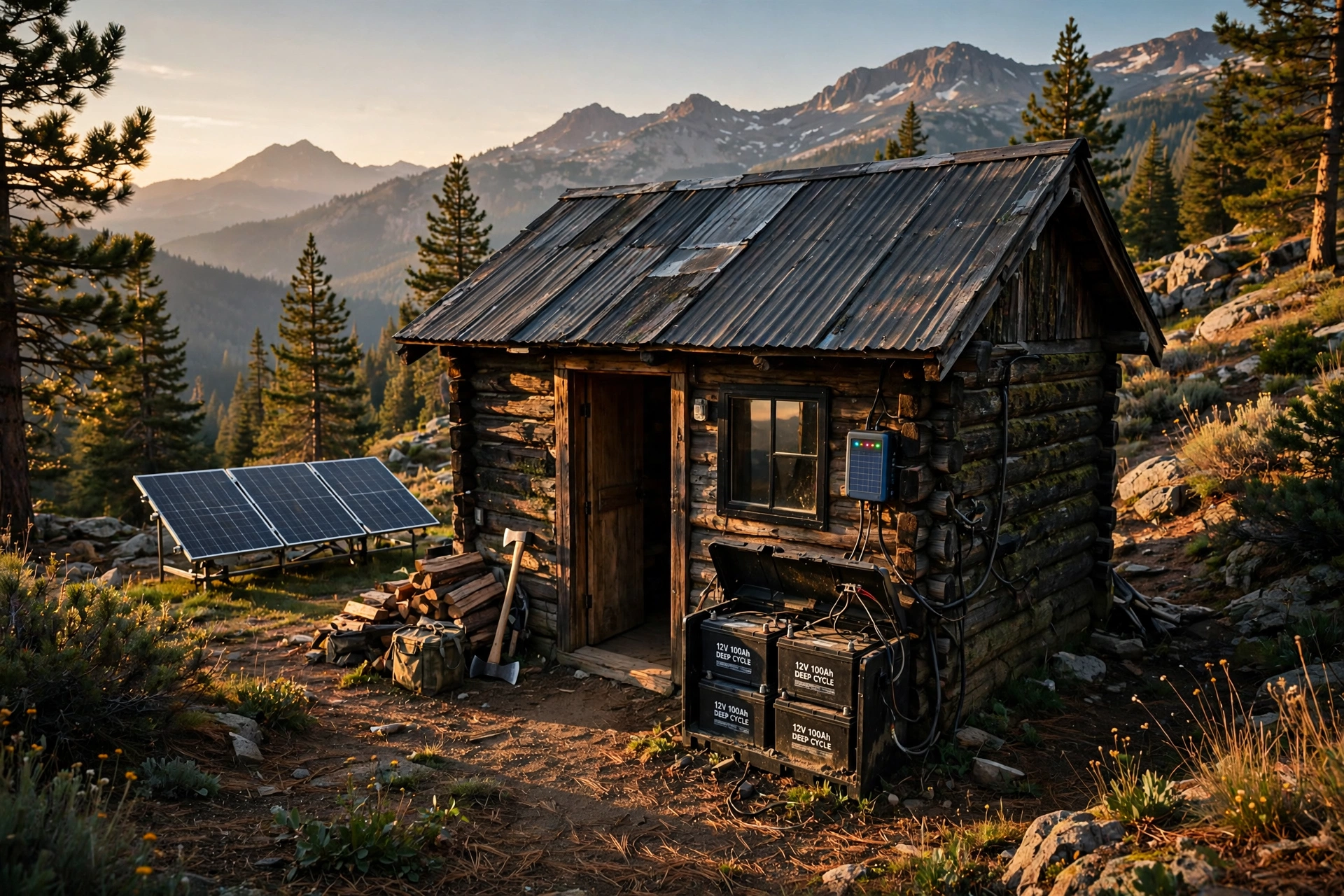
The short answer: for a fixed off-grid cabin, the best solar panel is the Renogy 200W N-Type rigid panel at $179.99 — the cheapest watts from a major brand that will sit outside for decades. If your setup moves — an RV, a seasonal camp, or a portable power station — the best off-grid solar panel is the Jackery SolarSaga 200W at $379, because it folds, angles, and plugs straight into the power station it was built for. The rest of this guide explains why those two win in their lanes, and how to size the system around them.
Disclosure: we may earn a commission if you buy through links on this page. That never decides what we recommend — brands cannot pay for placement. See our disclosure for the full policy.
How we researched this: this is a research roundup, not a hands-on test. Picks are based on published specs, manuals, owner reports, and independent measurements as of October 2026. Prices are US list prices checked in October 2026 and move often — treat them as a snapshot, not a quote.
Off-grid means the panel is only one part of the system
On a rooftop install, the grid is the backup: if the panels underproduce, the house just buys power. Off-grid, there is no backup. The panel, the charge controller, the battery, and the inverter have to work as one system, and the weakest link decides whether the lights stay on.
The chain works like this. Sunlight hits the panel and makes DC electricity. The charge controller feeds that variable DC to the battery at the right voltage and current — too much and the battery cooks, too little and it never fills. The battery stores energy for night and cloudy stretches. The inverter turns stored DC back into AC for normal household plugs. A panel with great specs paired with an undersized battery is a system that makes power at noon and has nothing left at 8 pm.
Winter sun hours, not peak watts, decide whether the system works
A 200W panel does not make 200W all day. It makes 200W for one hour under perfect lab conditions — direct sun, 25°C cell temperature, clean glass. Real output is measured in watt-hours, and the number that matters is peak sun hours: how many hours of full-strength sun your site gets in a day.
Much of the US gets about 5–6 peak sun hours on a June day and only 2–3 on a December day. So the same 400W array that makes about 1,500 Wh on a summer day (400 × 5 × 0.75 for losses) makes about 900 Wh on a winter day (400 × 3 × 0.75). The 0.75 factor covers real-world losses: heat, controller conversion, wiring, dust, and a less-than-perfect angle. Size for December and June takes care of itself: a typical efficient 12V compressor fridge lands around 500–700 Wh over a full day, so a 200W array barely covers the fridge alone in winter. That is why the picks below start at 200W and the serious cabin pick is 400W.
Rigid vs portable: pick by whether the panel moves
Rigid panels are glass, an aluminum frame, and a fixed mount. They cost the least per watt, survive hail and snow load, and are typically warranted to keep producing at 80% of original output after 25 years. Their weakness is that they are heavy and fixed: whatever angle you bolt them at is the angle they keep all year.
Portable panels fold up, weigh a fraction as much, and come with kickstands so you can re-angle them through the day. They cost two to three times as much per watt, and their ETFE plastic faces will not outlast glass. Their strength is flexibility: they pack into an RV bay, charge a portable power station directly, and follow the sun.
| Rigid panels | Portable panels | |
|---|---|---|
| Best for | Fixed cabin, shed, or RV roof | RV trips, camping, power stations |
| Cost per watt | About $0.90–$1.10 | About $1.90–$2.75 |
| Weight (200W) | About 23 lbs | About 14 lbs |
| Lifespan | 25-year output warranty is standard | 2–5 year warranty is typical |
Cell type matters less than the marketing suggests. Nearly every panel sold today is monocrystalline. The newer N-type and TOPCon cells hold output better in heat and degrade more slowly than the older PERC cells they replace — Renogy’s N-type line and Jackery’s TOPCon panels both claim about 25% cell efficiency, against about 22–23% for standard PERC panels. That is a real but modest edge: a few percent more energy from the same roof space. Do not pay double for it.
The best solar panels for off-grid use, compared
Prices checked October 2026 from manufacturer stores and major retailers; the ranking is by value and system fit, not by a sale price on one day.
| Panel | Watts | Size (in) | Weight | Cell type | Price |
|---|---|---|---|---|---|
| Renogy 100W 12V Monocrystalline | 100W | 41.8 × 20.9 × 1.4 | 14.1 lbs | Mono PERC | $94.95 |
| Renogy 200W N-Type rigid | 200W | 49.7 × 30.1 × 1.2 | 23.4 lbs | N-type mono | $179.99 |
| Renogy E.Flex 200W portable | 200W | 23.7 × 23.0 × 2.0 folded | 13.9 lbs | N-type mono | About $250 |
| Jackery SolarSaga 200W | 200W | 92.1 × 21.7 × 1.0 unfolded | 13.7 lbs | TOPCon mono, bifacial | $379 |
| EcoFlow 400W Portable | 400W | 42.0 × 94.1 × 1.0 | 35.3 lbs | Mono | About $599 |
| EcoFlow 400W Rigid | 400W | 67.8 × 44.6 × 1.4 | 48.1 lbs | Mono | $999 |
Renogy 100W 12V Monocrystalline — best starter panel
The classic 100W rigid panel is the cheapest way into off-grid solar: $94.95 at Home Depot as of late September 2026, for a glass-and-aluminum panel with a 25-year output warranty behind it. At 41.8 × 20.9 inches and 14.1 lbs it fits on a shed roof, a small RV, or a simple ground mount. Its open-circuit voltage of 24.3V and operating voltage of 20.4V pair cleanly with any 12V battery bank through a basic charge controller.
One 100W panel is not a cabin system. It makes about 225 Wh on a winter day (100 × 3 × 0.75) — enough to keep a battery topped up, run lights and phones, and charge a small power station. Its real job is as a first panel: buy one, learn the wiring and controller on a small system, then add identical panels later. Two of them make a 200W array for under $200, still the cheapest path to a working off-grid setup. Renogy also sells a newer N-type 100W version at $109.99 with a smaller footprint (34.1 × 22.8 inches); if the price gap is small when you buy, take the N-type.
Renogy 200W N-Type rigid — best overall off-grid panel
This is the pick for most fixed off-grid setups. At $179.99 from Renogy, it costs under $0.90 per watt — the best price per watt on this list from a major brand — with N-type cells rated at 25% efficiency and a 10-year materials warranty plus a 25-year 80% output guarantee. The panel measures 49.7 × 30.1 × 1.2 inches and weighs 23.4 lbs, small enough for one person to mount on a cabin roof or a ground rack.
Two details matter for system building. First, the 200W N-type is a 24V-nominal panel with an open-circuit voltage of 37.44V, so it works with 12V and 24V battery banks through an MPPT controller — but check your controller’s maximum input voltage before wiring two in series, because two in series reach about 75V open-circuit. Second, Renogy prices the 2-pack at $352.99, which makes the standard cabin starter array — 400W of rigid panels — cost about $353 before controller and battery.
Renogy E.Flex 200W — best portable panel for the money
The E.Flex 200W is the portable panel that makes the Jackery’s price hard to defend. It folds to 23.7 × 23.0 × 2.0 inches, weighs 13.89 lbs, uses the same 25% N-type cells as Renogy’s rigid line, and carries an IP65 rating with four kickstands and a 45W USB-C PD port. It outputs through MC4 connectors to a controller or a power station.
The 200W version lists around $250 — roughly $1.25 per watt, about half the Jackery’s cost per watt for the same output at a similar weight. Independent testing by Outdoor Gear Lab measured 177W real-world output from a 200W Renogy portable against 171W from the Jackery SolarSaga 200W, within the margin of a cloudy afternoon. Buy this one if you want a folding panel for a power station or an RV and you do not already own a Jackery.
Jackery SolarSaga 200W — best portable panel for Jackery owners
The SolarSaga 200W is the most expensive 200W panel on this list at $379 on Jackery’s own store ($50 off the $429 list), and it earns that price in exactly one situation: you already own a Jackery power station. The panel is built for that pairing — bifacial TOPCon cells rated at 25% conversion, an IP68 waterproof rating that beats the Renogy’s IP65, a built-in cable with USB-A and USB-C ports, and a solar-angle guide that helps you aim it. It folds to 24.2 × 21.7 × 1.6 inches and weighs 13.67 lbs.
Independent testing measured 171W of real output from its 200W rating, about 86% of nameplate — normal for a portable panel in field conditions, and close to the Renogy’s measured 177W. The case for buying it is integration, not watts: it plugs into Jackery stations with no adapters, no voltage guesswork, and no separate controller. If you run an EcoFlow or another brand’s power station, the Renogy E.Flex gives you the same watts for about $130 less.
EcoFlow 400W Portable — best big portable panel
When 200W is not enough and the panel still has to move, the EcoFlow 400W portable is the step up: one folding panel, 42.0 × 94.1 inches unfolded, rated at 400W with 22.4% efficient monocrystalline cells and an IP68 rating. It comes with a built-in XT60 cable that plugs straight into EcoFlow power stations, and its protective case folds out into an adjustable stand. EcoFlow’s US store listed it at $599 against a $699 list price in September 2026; some retailers list it as high as $1,099.
The weight is the honest trade-off: EcoFlow’s spec sheet lists the panel at 35.3 lbs (41.9 lbs with the kickstand case), a two-handed carry, not a backpack panel. This panel makes sense for a base camp, a large RV, or a Delta-series power station that can take 400W of solar input. It does not make sense as a first panel: a pair of rigid 200W Renogys costs about $353 and makes the same watts permanently mounted.
EcoFlow 400W Rigid — best panel for a fixed cabin array
For a cabin that needs serious power from a small number of panels, the EcoFlow 400W rigid panel is the fixed-mount counterpart to the portable above: 67.8 × 44.6 × 1.4 inches, 48.1 lbs, monocrystalline cells at 23% efficiency, and an open-circuit voltage of 37.1V that suits 24V and 48V battery banks. It is the only rigid panel on this list sold with matching mounting feet.
The price is the problem: $999 on EcoFlow’s US store, where it was listed out of stock at the time of writing, and it is usually sold in multi-panel bundles rather than singly. At $2.50 per watt it costs nearly three times the Renogy 200W N-type per watt. Buy it only if you need 400W from a single panel footprint and you are already building around EcoFlow equipment. For everyone else, two Renogy 200W panels give the same 400W for about $650 less.
How to size panels to your daily needs
Do the arithmetic before you buy anything — it is the difference between a system that works in February and one that does not.
- List your loads in watt-hours. Watts × hours used. LED lights: 10W × 5 hours = 50 Wh. Laptop: 60W × 4 hours = 240 Wh. 12V fridge: about 500–700 Wh a day. Phone charging: about 20 Wh. Add them up.
- Divide by winter sun hours × 0.75. If your daily total is 900 Wh and your site gets 3 peak sun hours in December, you need 900 ÷ (3 × 0.75) = 400W of panels.
- Size the battery to cover the dark stretch. A 100Ah 12V LiFePO4 battery holds about 1,280 Wh rated and a little over 1,000 Wh usable — about one day of the 900 Wh load above. Two days of autonomy, the standard target for off-grid cabins, means doubling the battery, not the panels.
- Check the controller. A 400W array on a 12V bank pushes about 33A at charging voltage, so your charge controller needs to handle that current and the array’s open-circuit voltage with headroom. An MPPT controller typically harvests 20–30% more than a PWM controller in cold weather. See the charge controllers hub for the full comparison.
The pattern that works for most small cabins: 400W of rigid panels, a 40A MPPT controller, and 100–200Ah of LiFePO4 storage. That runs lights, communications, a laptop, and an efficient fridge through winter in most of the US — and it leaves a clear upgrade path, adding identical panels and another battery rather than replacing anything.
Ground mount vs roof mount
Ground mount is the better default for off-grid cabins. You can set the tilt steeply for winter sun (your latitude plus 15 degrees is the usual rule of thumb), adjust it twice a year, and clear snow with a broom instead of a ladder. The cost is a simple lumber-and-concrete rack and a longer, thicker wire run to the battery.
Roof mount wins when ground space is limited or the panels need to be out of reach. The trade-offs are a fixed angle, harder snow clearing, and roof penetrations that have to stay watertight for decades. On an RV, the roof is usually the only option, and the panel’s low profile matters more than its tilt — which is why the Renogy N-type’s 1.2-inch depth and 23.4 lb weight are worth noting for van and RV roofs.
Leaving room to expand
Off-grid systems grow: the fridge gets bigger, a Starlink dish arrives, someone buys a power tool. Three rules keep expansion cheap. First, buy a charge controller one size up — a 40A MPPT controller on a 400W array leaves room to add a third panel later without replacing the controller. Second, buy identical panels when you expand — same model, same voltage, same current, so the array stays balanced. Third, keep battery voltage in mind — a 12V system is fine up to about 1,000W of panels, but past that, 24V or 48V keeps currents and cable sizes manageable.
The bottom line
For a fixed off-grid cabin, buy rigid panels and size for winter: two Renogy 200W N-Type panels ($353 for the pair), a 40A MPPT controller, and 100–200Ah of LiFePO4 storage will run a small cabin’s essentials year-round. For a setup that moves, buy a folding panel matched to your power station — the Renogy E.Flex 200W for value, the Jackery SolarSaga 200W if you already own a Jackery. Whatever you buy, do the watt-hour math first: the panel is the cheapest part of an off-grid system, and the most expensive mistake is buying the wrong size.
Browse the full range in our solar panels hub, and pair your panels with the right storage from our batteries hub.