
The short answer: the best portable power station under $1000 is the Anker SOLIX C1000 Gen 2. It packs 1,024Wh of LiFePO4 battery, a 2,000W inverter, a 600W solar input and a 49-minute wall recharge into the lightest unit in this class, and it sells for about $530 direct from Anker against a $699.99 list price. Nothing else under $1,000 matches that combination of output, speed and weight. The Jackery Explorer 1000 v2 is the closest rival if you value the lightest carry and the strongest brand support network, and the Pecron E1000LFP is the value pick at about $399.
Disclosure: this site may earn a commission if you buy through a link on this page, at no extra cost to you. See our disclosure for the full details.
How this guide was researched: every specification and price below comes from the manufacturer’s own published specs and store pages, cross-checked against a second source, as of October 2026. We have not hands-on tested these units; this is a research roundup built on published specs, owner reports and published measurements. Prices move with sales, so treat the figures here as the price at research time, not a live quote.
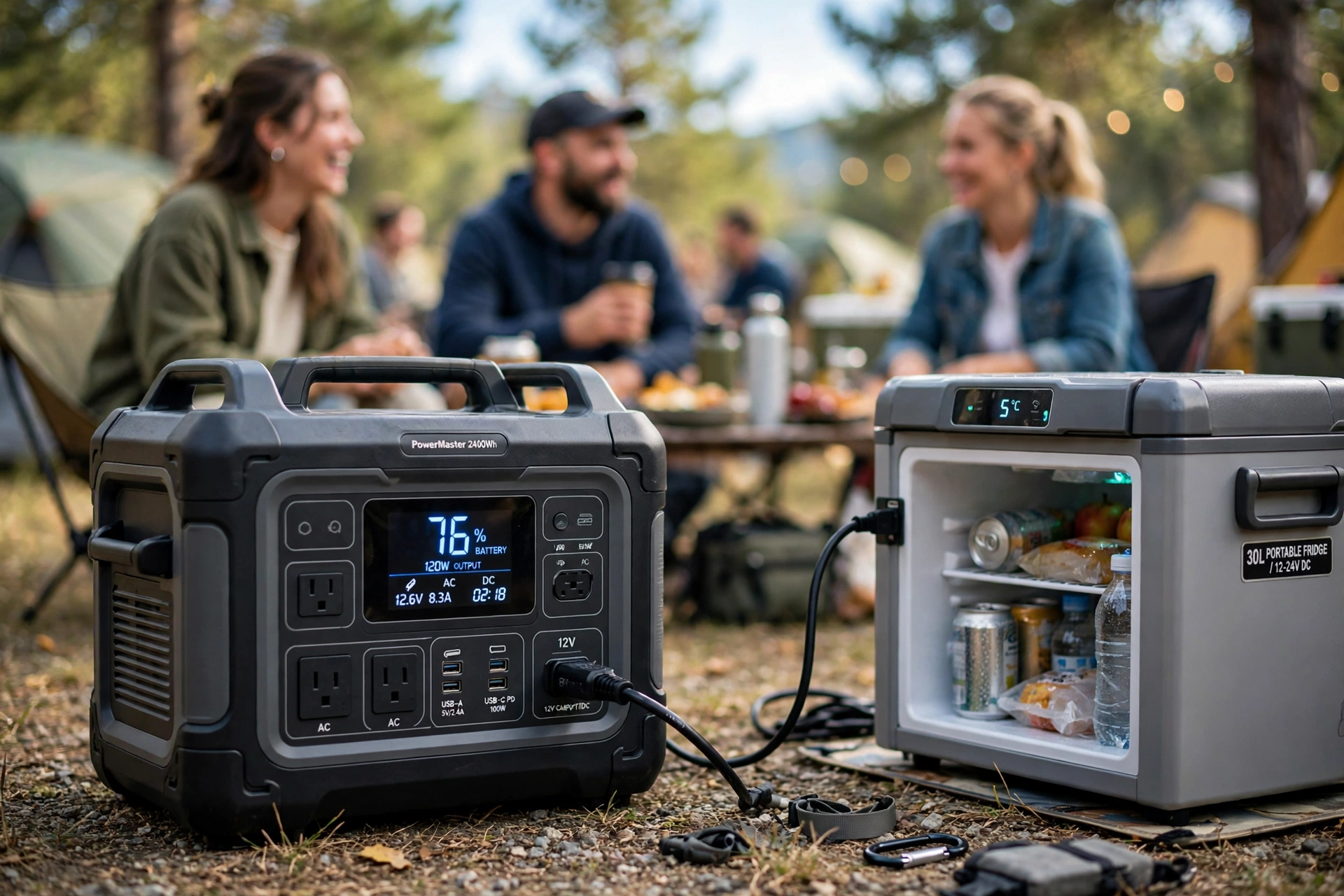
The photo above is illustrative: it shows the kind of setup these stations power, not the specific model we recommend.
Why so many “under $1,000” guides answer the wrong question
Search this keyword and you will notice something odd: several of the top guides actually answer “under $500”. That is the intent mismatch this page exists to fix. The under-$500 band and the under-$1,000 band are different products for different jobs, and a guide that mixes them up leaves you comparing a 500Wh station against a 1,000Wh one as if the only difference were price.
The real difference is what the extra money buys, and it is not just a bigger number on the box. Three numbers decide what a power station can do, and the under-$1,000 band improves all three at once.
The three numbers that matter: Wh, W, and solar watts
A portable power station is three machines in one box: a battery, an inverter, and a charge controller. Each one has a number, and each number answers a different question.
Watt-hours (Wh) is the size of the tank. It answers “how long will it run?” A 1,024Wh battery holds about 870Wh of usable energy once you account for inverter losses of roughly 15 percent. Divide that by the watts your device draws and you get hours. A 50W camping fridge: about 17 hours. A 60W laptop: about 14 hours. A 1,500W space heater: about 35 minutes. Capacity is the number everyone quotes first, and it is the least informative on its own, because a big tank with a narrow pipe still cannot run a fridge.
Inverter watts (W) is the width of the pipe. It answers “what can it run at all?” The inverter converts the battery’s DC power into the AC power your appliances expect, and any single device — or combination of devices — that draws more than the inverter’s continuous rating will trip it. This is the number that separates the bands. Under-$500 stations typically offer 500 to 1,000W, which covers phones, laptops, lights and a small fan. The under-$1,000 band offers 1,500 to 2,000W, which adds the appliances with motors and heating elements: a fridge compressor starting up, a microwave, a coffee maker, a portable air conditioner. If the station cannot start your fridge, its capacity is irrelevant.
Solar input watts is the refill rate. It answers “how fast can the sun refill the tank?” A station with a 200W solar input takes two full days of good sun to refill 1kWh. A station with a 500 to 600W input does it in about one day, or about three hours with 400W of panels connected. For camping, RV and off-grid use, this number matters as much as capacity, because a station you cannot refill is a station with one day of power.
The under-$1,000 band is where all three numbers cross a useful threshold together: about 1,000Wh of capacity, about 1,800W of inverter, and 500 to 600W of solar input. Below that band you give up at least one of the three. Above it — the 2kWh, 2,400W home-backup class — you pay roughly double for capacity you may not need, and the unit stops being genuinely portable at 60-plus pounds.
Comparison table: five models genuinely under $1,000
Every model below is a current model with a LiFePO4 battery, verified against the manufacturer’s own specs and store pages in October 2026. Prices are the manufacturer’s direct price at research time; list prices are shown where the sale price differs.
| Model | Capacity | Inverter | Battery | Solar input | Weight | Price |
|---|---|---|---|---|---|---|
| Anker SOLIX C1000 Gen 2 | 1,024Wh | 2,000W | LiFePO4, 4,000 cycles | 600W | 24.9 lbs | $529.99 (list $699.99) |
| Jackery Explorer 1000 v2 | 1,070Wh | 1,500W | LiFePO4, 4,000 cycles | 400W | 23.8 lbs | $499 (list $559) |
| EcoFlow Delta 2 | 1,024Wh | 1,800W | LiFePO4, 3,000 cycles | 500W | 27 lbs | List $999, routinely discounted to about $400–500 |
| Bluetti AC180 | 1,152Wh | 1,800W | LiFePO4, 3,500+ cycles | 500W | 35.3 lbs | $499 (list $999) |
| Pecron E1000LFP | 1,024Wh | 1,800W | LiFePO4, 3,500+ cycles | 600W | 29 lbs | $399 (list $799) |
How long will a 1kWh station actually run things?
Use the 85 percent rule: multiply the rated capacity by 0.85 to get usable energy, then divide by the device’s average draw. These are estimates for a 1,024Wh station, not lab measurements, and a fridge’s draw depends on ambient temperature and how often the compressor cycles.
| Device | Average draw | Estimated runtime from 1,024Wh |
|---|---|---|
| Camping fridge (12V compressor) | About 50W | About 17 hours |
| Full-size fridge | About 150W | About 6 hours |
| Laptop | About 60W | About 14 hours |
| LED lights + phones | About 20W | About 43 hours |
| Microwave | 1,000W | About 50 minutes |
| Coffee maker | 800W | About 1 hour |
Jackery’s own published runtime for the Explorer 1000 v2 — 15 hours running a 60W portable fridge — lands exactly on this calculation (1,070Wh × 0.85 ÷ 60W ≈ 15 hours), which is a useful cross-check that the rule is honest.
Anker SOLIX C1000 Gen 2 — best overall
1,024Wh · 2,000W · LiFePO4 · 600W solar · 24.9 lbs · $529.99 (list $699.99)
The Gen 2 is the pick because it wins the number that matters most in this band: inverter output. At 2,000W continuous (3,000W peak) it runs a full-size fridge, a microwave, or a coffee maker alongside a laptop, where the 1,500W Jackery would trip. It is also the fastest to recharge — 49 minutes from a wall outlet with HyperFlash enabled, and about 1.8 hours from 600W of solar — and the lightest of the five at 24.9 pounds. The LiFePO4 battery is rated for 4,000 cycles to 80 percent capacity, and Anker backs it with a 5-year warranty and a sub-10ms UPS switchover for CPAP machines and routers.
The trade-off is real: unlike the original C1000, the Gen 2 cannot take an expansion battery, so 1,024Wh is the ceiling. If you think you will want 2kWh later, buy the original C1000 or the EcoFlow Delta 2 instead. For everyone else, the Gen 2 is the most capable box under $1,000.
Anker SOLIX C1000 Gen 2 on Anker’s site
Jackery Explorer 1000 v2 — lightest carry
1,070Wh · 1,500W · LiFePO4 · 400W solar · 23.8 lbs · $499 (list $559)
The v2 is the lightest unit here at 23.8 pounds and the most genuinely portable: it is the one you will actually carry from the car to the campsite without thinking about it. It has the largest capacity of the five at 1,070Wh, a 1,500W inverter (3,000W surge), and the same 4,000-cycle LiFePO4 rating as the Anker — though Jackery rates its cycles to 70 percent capacity rather than 80 percent. It recharges from a wall outlet in about 1 hour in emergency mode, or 1.7 hours in standard mode.
The weakness is solar input: 400W maximum across two 200W inputs, against 500 to 600W for the rest of the table. That means a slower solar refill — about 7.5 hours from a single 200W panel, per Jackery’s own figures. If your plan is to recharge mostly from the wall and carry the unit often, the v2 is the right call. If you plan to live off solar for days, the Anker or Pecron refills faster.
Jackery Explorer 1000 v2 on Jackery’s site
EcoFlow Delta 2 — most expandable
1,024Wh · 1,800W · LiFePO4 · 500W solar · 27 lbs · List $999, routinely discounted to about $400–500
The Delta 2 is the oldest design here and still the most flexible. Its 1,800W inverter (2,700W surge, with X-Boost handling loads up to 2,200W) covers nearly every household appliance, and it is the only model in this table besides the Pecron that grows: add a Delta 2 extra battery for 2,048Wh, or a Delta Max extra battery for 3,040Wh. It charges 0 to 80 percent in about 50 minutes from the wall, takes 500W of solar, and carries a 5-year warranty.
The catch is the price. Its list price is $999, which sits exactly on the ceiling of this roundup, but EcoFlow discounts it aggressively and routinely — recent sale prices have fallen to about $400–500. At list price it is the worst value here; on sale it is one of the best, and the expandability is the tiebreaker if you expect your needs to grow.
Bluetti AC180 — most capacity per dollar
1,152Wh · 1,800W · LiFePO4 · 500W solar · 35.3 lbs · $499 (list $999)
The AC180 has the biggest battery in this comparison at 1,152Wh, an 1,800W inverter with a 2,700W Power Lifting mode, and a 3,500-plus-cycle LiFePO4 battery, all for $499 at research time against a $999 list price. On capacity per dollar it is the strongest value of the brand-name models.
It pays for that capacity in weight: 35.3 pounds makes it the heaviest unit here by a clear margin, and the most awkward to carry to a campsite. It is also not expandable. Buy the AC180 if it will mostly live in one place — an RV, a cabin, a garage shelf for outages — and the extra 128Wh over the 1,024Wh models matters more to you than carrying it.
Bluetti AC180 on Bluetti’s site
Pecron E1000LFP — best value
1,024Wh · 1,800W · LiFePO4 · 600W solar · 29 lbs · $399 (list $799)
The Pecron is the cheapest way into this band by a wide margin: $399 against a $799 list price, for the same 1,024Wh and 1,800W as the Delta 2, plus the joint-best 600W solar input and expansion to 4,096Wh with an EP3000 battery. Its LiFePO4 battery is rated for 3,500-plus cycles, and it recharges from the wall in about 1.3 hours.
The compromise is the brand: Pecron is a smaller, newer maker than Anker, Jackery, EcoFlow or Bluetti, with a thinner dealer and support network and a shorter 2-plus-1-year warranty. The specs are the equal of anything here; the question is how much you value the bigger brands’ support if something goes wrong in year three. If the budget is the constraint, this is the pick.
Pecron E1000LFP on Pecron’s site
Who needs this band, and who should stay under $500
Buy in the under-$1,000 band if any of these are true:
- You need to run a fridge. A compressor fridge’s startup surge and continuous draw need a 1,500W-plus inverter and about 1kWh of capacity. Under-$500 stations with 500 to 1,000W inverters will trip or drain in hours.
- You need a day of real power, not an evening. Phones, laptops, lights and a fan are under-$500 jobs. A fridge plus a laptop plus lights through a full day, or an overnight outage with a CPAP machine, is a 1kWh job.
- You will recharge from solar. The 500 to 600W solar inputs in this band refill the battery in a day of sun. A 200W-input station takes two days, which is the difference between a working system and a dead battery on day two of a trip.
- You want home backup for essentials. A 1kWh station keeps a fridge, a router, phones and a few lights going through an outage of about 6 to 12 hours, depending on the fridge.
Stay in the under-$500 band if your loads are only phones, laptops, cameras and lights, you camp for a single night at a time, or the station will live in a car for emergencies. The extra capacity buys nothing if you never draw more than 300W.
Where this band ends and home backup begins
One line is worth drawing clearly: a 1kWh station is portable backup, not whole-home backup. It runs one fridge and a handful of essentials. It does not run a home. Whole-home backup starts at about 2kWh of capacity and 2,400W of inverter — units like the Bluetti AC200L (2,048Wh, 2,400W, 1,200W solar input) — which weigh 60-plus pounds and cost more than $1,000 at list price. The AC200L does dip under $1,000 on sale (about $899 was listed on Bluetti’s own comparison page in October 2026, against a $1,099 standalone price), so watch for it if you want the bigger class without the bigger budget — but buy it only on sale, and only if you are happy carrying 61.6 pounds.
If you are building a system rather than buying a box, the station is half the purchase. A 200W portable panel is the right companion for any model here, and a 400W setup is what makes multi-day off-grid use work. See our portable solar panels hub for panels to pair with these stations, and browse the full power stations hub for the rest of the range.
The bottom line
The under-$1,000 band is the sweet spot in portable power right now: 1kWh of LiFePO4 capacity, a 1,500 to 2,000W inverter and a 500 to 600W solar input, all for $400 to $700 at current sale prices. The Anker SOLIX C1000 Gen 2 is the best all-round buy for most people. The Jackery Explorer 1000 v2 is the one to carry. The EcoFlow Delta 2 is the one to grow with. The Bluetti AC180 is the one to park in an RV. And the Pecron E1000LFP is the one to buy when the budget is the deciding factor. Whichever you choose, check the current price before you buy — every model in this roundup is routinely discounted well below its list price.